Physical Address
304 North Cardinal St.
Dorchester Center, MA 02124
Physical Address
304 North Cardinal St.
Dorchester Center, MA 02124


By Dr. Santiago Fronda, PhD, MBA
Author of The Green Frontier and Renewable Energy Project Management
Introduction: The Milestones That Make-or-Break Bankability
Alfredo, you’ve done the hard work. Your feasibility studies are robust, validated by industry advisors, and grounded in realistic assumptions—your off-takers, whether industrial users, utilities, or traders, are actively negotiating off-take terms. Your financial model reveals a strong internal rate of return (IRR), and your project’s emissions reduction potential aligns perfectly with global net-zero goals.
But let me ask you the question that every investor is silently thinking:
“Where exactly are you on the capital readiness continuum?”
It’s not just about how bankable your project looks on paper. It’s about where it stands in the sequence of key investment milestones—and whether the right strategic decisions have been made at the right time.
In the high-stakes world of renewable energy project finance, the difference between a Final Investment Decision (FID) and a Financial Close (FC) is more than terminology. It defines the line between internal commitment and external capital flow, between project ambition and execution reality.
Why the Distinction Matters
In our work advising on green hydrogen hubs, advanced biofuel refineries, and large-scale solar-ammonia complexes, we’ve seen this again and again: promising projects falter not because the market wasn’t there or because the technology failed—but because FID and FC were misunderstood, misaligned, or mishandled.
Let’s be clear:
Misaligning these two gates can derail the entire project.
Capital Readiness Is Not Binary—It’s a Milestone-Based Journey
Investors, DFIs, ECAs, and impact capital funds don’t look at projects as either “bankable” or “not.” They assess whether your project is advancing through a structured, risk-mitigated journey toward financial close and final investment decision.
Understanding where your project is along this continuum—and communicating that clearly—can:
For Project Leaders Like Alfredo
Whether you’re managing a $200 million solar and battery energy storage system (BESS) facility or a $2 billion green ammonia plant, your leadership hinges on one thing: navigating milestones with precision.
FID and FC are not just two points on a timeline. They are gates of trust, where sponsors, investors, and lenders each take a leap of faith—based not on hopes but on demonstrated readiness.
In this article, we’ll break down:
Understanding FID and FC isn’t just finance jargon—it’s your blueprint for building bankable, investable, and executable green infrastructure.
Why This Matters to Project Leaders Like Alfredo and you?
If you’re managing a green hydrogen facility, an advanced biofuel refinery, or a solar-plus-storage park, understanding the FID vs. FC divider helps you:
Remember: Investors won’t release capital at the Final Investment Decision (FID). But you can’t reach FC without it.
Section 1: What Is the Final Investment Decision (FID)?
In the lifecycle of project development, the Final Investment Decision (FID) is a pivotal internal commitment made by the project sponsor, board of directors, or investment committee to formally advance a project from planning into execution preparation. While not yet involving external lenders or binding financial contracts, FID signals that the project has passed internal investment-grade standards across technical, commercial, and ESG domains.
To reach FID, developers must typically demonstrate that the project:
FID is often supported by third-party validation, such as:
Quote: “It’s the sponsor’s green light—before the banker’s pen hits paper.”
Once FID is achieved, the project unlocks critical activities necessary to maintain momentum toward Financial Close (FC):
FID empowers sponsors to:
While FID is a major inflection point, the project still relies heavily on equity risk capital until the financial close (FC). Any delays in reaching FC can strain equity reserves, especially in markets where EPC costs escalate or permitting timelines are uncertain. For this reason, many sponsors treat FID as a conditional investment, subject to a defined pathway and timeline for reaching FC.
Key Insight:
FID is not the endgame. It’s the start of a high-risk, high-velocity sprint toward Financial Close.
As a project leader managing a $500M+ renewable infrastructure pipeline, Alfredo must align her internal stakeholders and board to the realities of FID. This includes:
While a Final Investment Decision (FID) is an internal commitment, Financial Close (FC) is the definitive external milestone where your project becomes financially binding and institutionally investable.
At this stage, all legal and commercial agreements with lenders and investors are fully executed, all conditions precedent (CPs) have been satisfied, and the initial capital drawdowns commence. In short, the project is now live—funds are flowing, risks are shifting, and accountability is locked in.
Once FC is achieved, your project transitions from development to delivery mode with the complete confidence of capital markets.
At FC, the capital stack is not just theoretical—it becomes enforceable.
A legally and financially bankable project requires a suite of meticulously negotiated documents. These include:
Key Insight:
Without Financial Close, there is no project finance. FID signals belief. FC guarantees bankability.
This is where even well-conceived projects often get stuck. The period between FID and FC is filled with critical tasks that determine if a project will move forward—or collapse under the weight of unresolved risks.
Even with FID secured and conditional approvals in hand, many projects stall in this gap due to misaligned execution, bureaucratic delays, or financing complications.
To guide your project through this critical stage, here’s a breakdown of common bottlenecks:
| Barrier | Impact |
| Outstanding Land Lease Agreements | Blocks title transfer, prevents financial close and affects the enforceability of the security package. |
| Delayed ESIA Approvals | Regulatory risk remains unmitigated, potentially breaching the Equator Principles or IFC Performance Standards. |
| Incomplete Grid Interconnection Agreements | Undermines the technical feasibility and bankability of off-take assumptions. |
| Unresolved Political/Insurance Risk Coverage | DFIs and ECAs may withhold approval if political or force majeure risks are unhedged. |
| Missing EPC Wrap Guarantees | Lenders require performance bonds or completion guarantees to underwrite construction risk. |
| Absence of Finalized Equity Security Instruments | Unclear shareholder commitments can hinder the execution of capital structure. |
“You’ve secured conditional debt approval from a leading Development Finance Institution (DFI). But until your grid interconnection study is finalized and your land tenure is legally confirmed, your FC remains on pause. Every month of delay erodes sponsor confidence and increases soft costs.”
To close this capital execution gap, project leaders must act with urgency, foresight, and discipline. Below are actionable strategies to ensure a smooth transition from sponsor approval to lender activation:
Negotiate land rights, secure grid capacity, and engage with regulatory bodies prior to FID. This reduces the number of CPs left hanging during FC negotiations.
Avoid issuing Notices to Proceed (NTPs) or signing major equipment purchase agreements (EPAs) before confirming lender disbursement timelines. Unaligned procurement can lead to the following:
Convene weekly coordination meetings with your:
These advisors are crucial in addressing CPs efficiently, identifying legal and documentary gaps, and expediting due diligence closure.
Adopt a “soft FC” mindset at the FID stage. Ensure that:
This strategic discipline reduces closing slippage and boosts investor trust.
In the capital-intensive world of green infrastructure development, FID and FC are not just technical milestones. They are trust gates—where credibility is either built or lost.
Alfredo, mastering the FID–FC transition gives you the power to:
For project leaders in the renewable energy and sustainable infrastructure space, FID and FC are not interchangeable. They are two critical gates—each with its own stakeholder expectations, documentation, and execution triggers.
FID is commitment. FC is capital.
Alfredo, mastering the timing and structure of both can be your greatest asset in delivering a bankable, buildable, and sustainable project.
📥 Downloadable Bonus:
✅ FID & FC Milestone Checklist for Renewable Energy Projects
Equip your team with a practical checklist covering the following:
🔗 [Download Now – PDF] (Insert downloadable link here)
Want More?
Subscribe to GreenFRONTIER for more insights on capital readiness, ESG finance, and project delivery frameworks for net-zero infrastructure.
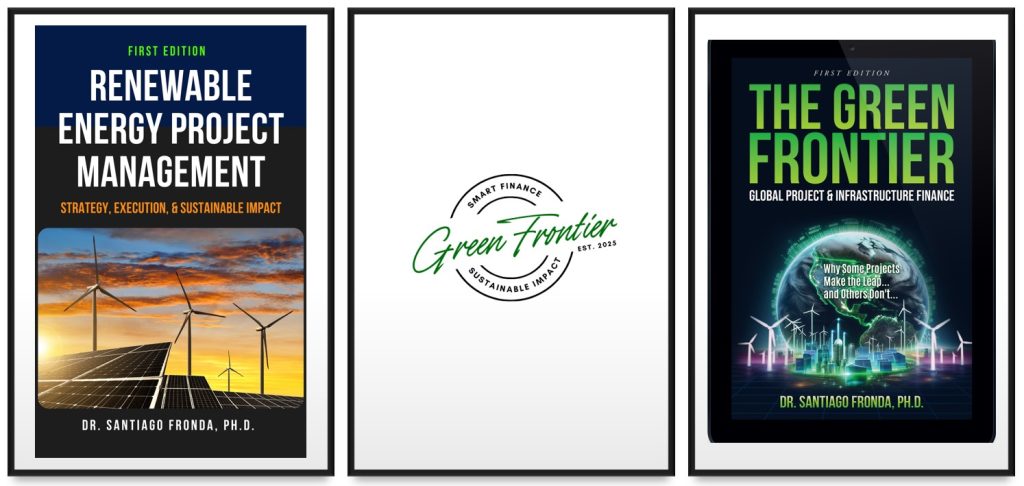
If you found this article helpful, explore Dr. Santiago Fronda’s globally recognized books:
📘 The Green Frontier: Global Project & Infrastructure Finance
A comprehensive playbook for sustainable finance, capital structuring, and green investment strategies.
📗 Renewable Energy Project Management: Strategy, Execution, and Sustainable Impact
A practical guide on leading complex renewable energy projects from concept to commissioning.
Both titles are globally available in digital format. 👉 Visit the Bookstore and Download Your Copy
Empower yourself with the tools trusted by project developers, financial institutions, and infrastructure leaders worldwide.
✒️ About the Author
Dr. Santiago Fronda, PhD is a global thought leader in renewable energy project development, infrastructure finance, and strategic leadership. As the author of The Green Frontier and Renewable Energy Project Management, he brings over 20 years of experience leading complex, billion-dollar infrastructure projects worldwide. Dr. Santiago is the founder of GreenFRONTIER—a platform that empowers finance professionals, developers, and sustainability leaders to deliver impactful, investable, and bankable clean energy solutio

Dr. Santiago Fronda, Ph.D., MBA, is a global leader in project and infrastructure finance, with over two decades of experience structuring multi-billion-dollar clean energy and sustainable infrastructure projects. As the author of The Green Frontier and Renewable Energy Project Management, and CEO of NEOX Development Services Group, Dr. Santiago helps developers, governments, and investors turn climate ambition into bankable projects.