Physical Address
304 North Cardinal St.
Dorchester Center, MA 02124
Physical Address
304 North Cardinal St.
Dorchester Center, MA 02124


By Dr. Santiago Fronda, Ph.D., MBA
Author of The Green Frontier & Renewable Energy Project Management
Founder, NEOX Development Services Group
You have a solid, clean energy project. The numbers work. The tech is sound. The impact is compelling.
Yet… capital remains elusive.
If this sounds familiar, you’re not alone. Every week, I meet visionary developers with technically robust, ESG-aligned infrastructure projects that still can’t get investors to say yes.
Why? Because capital doesn’t chase potential. It follows clarity, structure, and risk-managed execution.
This blog reveals why even good projects struggle to attract funding—and what you can do to fix it fast. At the end, download your free Investor-Ready Project Checklist to start turning interest into investment.
Many project developers—especially in emerging sectors like green hydrogen, ammonia, and advanced biofuels—assume that if their project has strong fundamentals, capital will follow. But here’s the hard truth:
Investors don’t fund potential—they fund de-risked, executable returns.
What separates fundable projects from stalled ones is often not the quality of the technology, the size of the market, or even the developer’s track record. It’s the presence of what I call the “Bankability Gap.”
This gap refers to the invisible chasm between project ambition and investor readiness. A project may look good on paper, but once you peel back the layers during due diligence, red flags emerge that make investors hesitant—or walk away.
A top-level, unverified feasibility report is a deal-breaker. Investors want:
A project model without dynamic features and sensitivity testing is essentially a guess. Investors need:
You may have market interest, but without offtake letters, capacity reservations, or indicative tariffs, it’s still speculative. Investors want:
Early-stage or weak EPC engagement introduces construction risk. You need:
Sustainability is no longer a box to tick—it’s a condition for capital. Expect scrutiny on:
Projects can’t progress without fuel. Many fail to budget for:
Without this, projects stall at concept phase, unable to move toward financial close.
Even post-FC, projects need liquidity to operate. Lenders and equity investors will flag:
Neglecting this signals poor financial planning and can kill your credibility.
Investor interest fades quickly without organized, high-quality documentation:
🛠 Solution: Build a data room from Day One—structured, up-to-date, and advisor-reviewed.
Investors trust deals guided by credible hands. Solo developers without:
…often struggle to cross the FID threshold.

The good news? This gap is not fatal—but it requires a deliberate, stage-gated process to bridge.
Your goal as a developer is to translate potential into precision. Not just a story, but a structure. Not just ambition, but alignment—with what investors are actually looking for.
📌 Every section of your PIM, every model tab, every permit, every contract must say:
“This project is real. It’s ready. And it will deliver.”
“Investors don’t chase potential. They follow structure, strategy, and trust.”
You know your project inside out: the electrolyzer specs, solar irradiance profile, technology providers, LCOE projections, even your feedstock logistics.
But when you sit down with an investor, they nod politely—then decline to proceed.
Why?
Because you’re telling a technical story, while they’re listening for a capital story.
Investors—especially institutional and infrastructure-focused ones—aren’t looking to understand the physics of your green ammonia plant or the chemistry behind biomass conversion. They’re asking:
If your presentation leads with technology and engineering—but fails to translate them into bankable returns—you’re missing the mark.
Here’s how seasoned project developers and financiers reframe their narrative:
1. Start with the Investment Thesis
2. Deconstruct Risk Like a Lender
3. Emphasize De-Risking Milestones
4. Align with Institutional Language
Use terms and structures investors recognize:
Capital Story Framework: Reframe These Elements
| Technical Focus | Capital-Focused Equivalent |
| Electrolyzer technology | Proven OEM with O&M guarantees |
| Solar resource yield (kWh/m²/year) | Long-term generation forecast → revenue base |
| Land secured | Bankable land lease with legal due diligence |
| Strong ESG profile | ESG strategy + third-party compliance pathway |
| EPC in negotiation | EPC term sheet with wrap, LDs, timeline |
| IRR of 15% | Levered IRR, DSCR, Payback, scenario tested |
“Investors don’t need to understand your project like an engineer—they need to trust it like an underwriter.”
Dr. Santiago FRonda, PhD.
Final Thought for This Section
Remember: you’re not pitching what you’re building—you’re pitching why it’s a safe and rewarding place to put money.

Think like an investor. Speak like a CFO. Structure like a risk manager.
You can have the right project… at the wrong time.
You can have eager investors… without a capital structure that fits their mandate.
You can have billions in potential… and still raise nothing.
That’s the reality when your capital structure lacks strategic alignment.
Investors don’t just look at how much you need—they look at how it’s structured.
If your project proposes:
…you’re giving them reasons to walk away.
In sustainable infrastructure, how you assemble capital is just as important as how much you raise.
Here are the most common red flags investors see in under-structured projects:
1. Unrealistic Capital Ratios
2. Poor Timing of Capital Phases
3. Undefined Risk Allocation in the Structure
4. Circular Dependency
This creates capital gridlock. No one moves first—so the deal doesn’t move at all.
Capital must be matched to project maturity and de-risked by design.
Here’s a practical roadmap:
| Project Stage | Capital Needed | Source Types | Key Investor Triggers |
| Concept → Feasibility | $1–5M | Developer equity, grants, incubators | Land secured, early modeling |
| Feasibility → FID | $5–30M | Strategic equity, concessional debt, DFIs | LOIs, permits, EPC engagement |
| FID → Financial Close | $50M–$500M | Anchor equity, ECA-backed debt, blended finance | Contracts signed, bankable model |
| Post-FC → COD | $500M+ | Green bonds, commercial project finance, institutional capital | Financial close achieved, drawdowns |
Note: Include working capital, contingency reserves, and debt service buffers in your model.
Your Project Information Memorandum (PIM) and pitch must:
“Investors don’t fund confusion. They fund clarity—especially in how capital is structured, sequenced, and protected.”
Dr. Santiago Fronda, PhD.
Great projects fail to raise money not because of their potential—but because of their capital messiness.
Tidy up your structure. Speak in terms of staged risk. Align your ask with real-world investor logic.
Today, every investor presentation includes the letters E-S-G—Environmental, Social, and Governance.
But here’s what many developers miss:
Saying you care about ESG isn’t enough. You have to prove it—systematically, transparently, and in alignment with investor-grade standards.
Investors—especially development finance institutions (DFIs), export credit agencies (ECAs), and institutional capital—are increasingly bound by ESG mandates, climate disclosure rules, and green taxonomies. For them, ESG is not just a matter of goodwill. It’s:
So when your PIM claims “strong ESG compliance” but your data room is missing:
…it undermines the credibility of your entire project.
1. ESG Is Claimed, But Not Documented
You mention alignment with IFC or SDG 13, but:
2. Community Engagement Is Overlooked
Lack of:
This creates perceived social volatility—a major red flag for capital.
3. No Measurable Impact Metrics
You talk about impact—but can’t quantify it.
Investors expect:
4. ESG Governance Is Missing
There is no ESG policy, no monitoring dashboard, and no dedicated ESG advisor or board committee.
Without these, ESG appears to be marketing—not governance.
| ESG Element | Proof Investors Expect |
| Environmental Compliance | IFC-compliant ESIA, biodiversity studies, climate risk model |
| Social License | Stakeholder maps, community consultations, grievance mechanism |
| Governance | ESG framework, KPIs, board oversight, third-party auditor |
| Alignment | Mapping to SDGs, EU Taxonomy, GHG reduction pathways |
| Impact | Measurable indicators with before-after projections |
Tip: Frame ESG not just as compliance—but as a risk mitigation and value enhancement strategy.
“In today’s capital markets, ESG isn’t a bonus—it’s a benchmark for credibility.”
Dr. Santiago Fronda, PhD.
Don’t let ESG be the reason your project stalls.
Investors want to fund projects that do good, do not harm, and can prove it.Embed ESG from the ground up—then show the receipts.
You’ve built a compelling financial model. Your feasibility study is robust. Your IRR is attractive.
But when it comes time to raise capital, the room is cold.
Why?
Because capital—especially in large-scale sustainable infrastructure—isn’t just deployed through numbers.
It moves through networks, reputation, and trust.
Raising capital for green hydrogen, biofuels, and ammonia infrastructure isn’t just about what you’ve built. It’s about who believes in your ability to build it.
Lenders and investors aren’t just evaluating your project—they’re evaluating:
Without these trusted relationships, your project often feels too early, too risky, or too disconnected—even if it’s technically viable.
1. Solo Developer With No Strategic Sponsors
You’re seen as high-risk if you’re the only party holding the development.
2. Advisors Are Junior or Unproven
Investors gauge your seriousness by your legal, technical, and financial advisors.
3. No Link to the Market or Policy Arena
Investors want to see:
4. Absence of Repeat Relationships
If this is your first major raise and you’re not leveraging any existing relationships (such as banks, legal firms, or ECAs), you appear as a cold lead in a warm market.
5. Relationship = Risk Mitigation
In a sector where:
…investors aren’t just betting on your asset—they’re betting on your ecosystem of delivery.
When these relationships are visible, documented, and engaged, your project becomes exponentially more investable.
Dr. Santiago Fronda, PhD.
“Investors don’t just fund projects—they fund people and the trusted teams behind them.”
🔚 Final Thought:
You can’t build bankability in isolation.
Trust is the multiplier that turns viable projects into fundable ones.
Build alliances early. Invest in the right advisors. Make credibility visible.
You now understand why many technically sound, high-potential projects struggle to raise capital:
The good news?
Each of these gaps is fixable—with the right strategy, structure, and deliberate action.
Final Thought: Bankability by Design
In today’s climate-driven infrastructure economy, capital is not the constraint—credibility is. Billions are earmarked for clean energy, but only a fraction of projects ever reach financial close.
Why? Because too many developers speak the language of technology, ambition, or climate impact—but not the language of capital.
Bankability isn’t a label. It’s a structure. A mindset. A discipline.
If your project is stalled at the capital raise, it may not be a problem of quality—but of alignment. Investors need to see precision, protection, and proof—not just promise.
Start with the checklist. Rethink your pitch. Restructure your capital plan. Engage trusted partners early.
Because in this green future we’re building, the winners won’t just be sustainable—they’ll be financially fluent.
📥 FREE Download: The Investor-Ready Project Checklist
Your step-by-step guide to ensure your project ticks the right boxes—before you pitch.
➡️ Download the Free Checklist (Link placeholder)
Use it to:
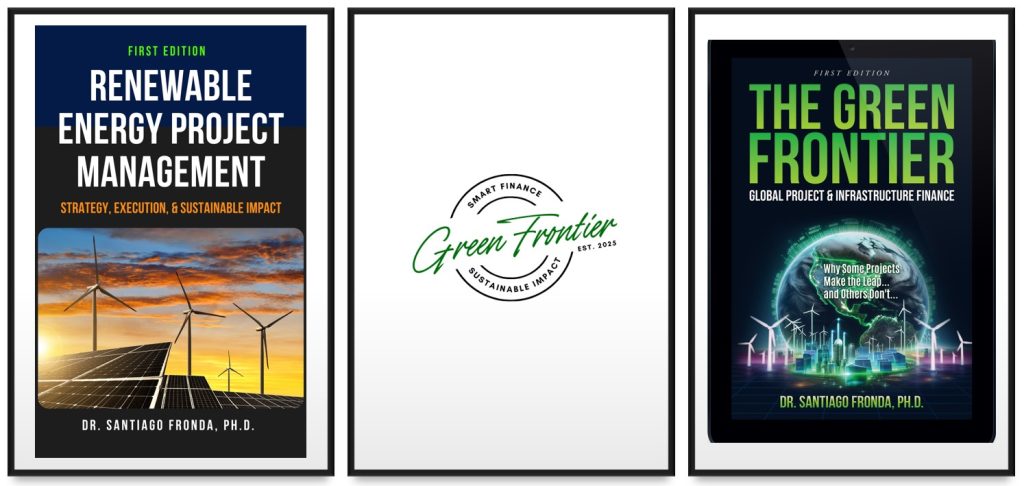
If you found this article helpful, explore Dr. Santiago Fronda’s globally recognized books:
📘 The Green Frontier: Global Project & Infrastructure Finance
A comprehensive playbook for sustainable finance, capital structuring, and green investment strategies.
📗 Renewable Energy Project Management: Strategy, Execution, and Sustainable Impact
A practical guide on leading complex renewable energy projects from concept to commissioning.
Both titles are globally available in digital format. 👉 Visit the Bookstore and Download Your Copy
Empower yourself with the tools trusted by project developers, financial institutions, and infrastructure leaders worldwide.
Dr. Santiago Fronda, PhD, MBA, is a global expert in sustainable infrastructure and project finance. As the author of The Green Frontier and Renewable Energy Project Management, and founder of NEOX Development Services Group, he assists project leaders, investors, and institutions in delivering high-impact renewable energy and infrastructure projects across Asia, Australia, and the Middle East. Dr. Fronda brings over 20 years of executive leadership, financial strategy, and capacity-building expertise to climate-aligned ventures worldwide.
Follow Dr. Santiago on LinkedIn for weekly insights on clean energy finance, ESG leadership, and capital-ready project development.

Dr. Santiago Fronda, Ph.D., MBA, is a global leader in project and infrastructure finance, with over two decades of experience structuring multi-billion-dollar clean energy and sustainable infrastructure projects. As the author of The Green Frontier and Renewable Energy Project Management, and CEO of NEOX Development Services Group, Dr. Santiago helps developers, governments, and investors turn climate ambition into bankable projects.