Physical Address
304 North Cardinal St.
Dorchester Center, MA 02124
Physical Address
304 North Cardinal St.
Dorchester Center, MA 02124


For Sofia, the Sustainable Infrastructure Strategist
By Dr. Santiago Fronda, Ph.D., MBA
Founder, NEOX Development Services Group
Author of The Green Frontier & Renewable Energy Project Management
In today’s global push for net-zero infrastructure, there’s no shortage of capital. What’s scarce, however, are projects that are truly bankable—those that demonstrate technical, financial, and governance integrity worthy of investment.
For project leaders like Sofia, who manage high-stakes renewable energy developments across Asia, Africa, and beyond, the stakes are rising. Sofia isn’t just building energy assets—she’s shaping the next chapter of sustainable development. But no matter how promising the technology or resources, without the right structure, even the most visionary projects stall.
This article breaks down the core anatomy of a bankable renewable energy project—equipping leaders like Sofia with the strategic lens and actionable tools to move confidently from concept to capital.
A renewable energy project becomes bankable not when it’s built, but when trust is engineered into every assumption, risk is mastered by design, and value is proven before a single watt is generated.
Dr. Santiago Fronda, Ph.D.
“Bankability” is not a theoretical metric—it is the real-world threshold of trust that determines whether a project is capable of attracting long-term capital from institutional lenders, development finance institutions (DFIs), export credit agencies (ECAs), or private equity investors.
It answers a simple but high-stakes question:
Will this project generate reliable, predictable cash flows over the next 15–25 years, under the scrutiny of financial, legal, and technical due diligence?
These are the six core attributes of a bankable project:
A bankable project uses proven, commercially deployed technology and provides independent verification of its technical performance and yield projections.
Example: The Bhadla Solar Park (India)—a 2.2 GW utility-scale project—secured low-cost capital due to its reliance on Tier 1 PV modules, validated resource assessments, and EPCs with an established track record (Bridge to India, 2022).
Lenders require clear permitting pathways, secured land rights, and a strong legal framework. Any ambiguity around these elements introduces project execution risk.
Example: A 160 MW wind project in Argentina failed to achieve financial close despite a signed PPA due to unresolved land disputes and uncertain permitting timelines, which heightened lender risk perception (World Bank PPP Lab, 2021).
A long-term offtake agreement with a creditworthy buyer is non-negotiable. Predictable, contracted revenue is the foundation of project finance.
Example: The DEWA 900 MW Solar PV IPP (Dubai) succeeded because of a 25-year fixed PPA with DEWA, a government-backed utility with strong creditworthiness (ACWA Power, 2021).
Your financial model must demonstrate robust performance under realistic and adverse conditions. Lenders will test assumptions across inflation, FX, construction delay, and revenue scenarios.
Example: A green hydrogen project in Australia had to recalibrate its model after initial projections overestimated production efficiency. The revised model—with sensitivity-tested CAPEX and opex inputs—restored investor confidence (CEFC, 2022).
Compliance with global ESG frameworks is now required by most DFIs, institutional investors, and impact funds.
Example: The Lake Turkana Wind Power Project (Kenya) aligned with IFC Performance Standards and engaged in robust stakeholder consultations, which helped secure over $650M in funding from Norfund, AfDB, and others (AfDB, 2020).
Each major risk—technical, operational, financial, political—must be contractually allocated to the party best equipped to manage it.
Example: A Brazilian bioenergy plant failed to attract debt financing until the EPC agreed to performance LDs (Liquidated Damages), shifting output risk away from the sponsor and satisfying lender requirements (IDB Invest, 2021).
Bankability is about engineering certainty in an uncertain world. The certainty comes from structure, not just vision.
Dr. Santiago Fronda, Ph.D.
“I’m developing a 120 MW solar PV project with hybrid storage in Southeast Asia. We’ve secured land and completed a feasibility study. Yet our lead lenders still flag concerns about permitting delays and unclear offtake terms. What am I missing?”
What Sofia is experiencing is a typical capital bottleneck: a project that appears promising but lacks full de-risking across all domains.
To unlock investment, she must deliver a development story where every risk has a defined owner, every contract supports cash flow certainty, and every assumption holds up under lender due diligence.
Let’s walk through the six essential building blocks Sofia must strengthen.
| Component | Why It Matters | Tools & Best Practices |
| 1. Feasibility & Resource Validation | Ensures the project performs as modeled | Bankable resource reports, grid capacity study, EPC input |
| 2. Bankable Contracts | Shifts risk and guarantees execution | PPA/offtake, EPC/O&M, interconnection, land, feedstock terms |
| 3. Legal & Permitting Clarity | Avoids delays that can derail timelines or financing schedules | Permitting tracker, legal due diligence, timeline commitments |
| 4. Financial Model Integrity | Validates economic logic and risk-return ratios under base and stress scenarios | Dynamic financial models, sensitivities, IRR/DSCR outputs |
| 5. Risk Mitigation Strategy | Protects against volatility (construction, market, policy, FX) | Guarantees, political risk insurance, ECAs, MDB support |
| 6. ESG & Impact Frameworks | Aligns with global investor mandates and sustainable capital flows | IFC PS, Equator Principles, SDG targets, ESG dashboard |
Each of these building blocks represents a vital part of the development journey—not just as technical checkboxes but as strategic signals to capital providers that the project is resilient, ready, and responsible.
“Projects don’t fail for lack of funding—they fail because they weren’t structured to manage risk.”
— From The Green Frontier: Global Project & Infrastructure Finance
This quote captures a fundamental truth in project development:
Capital is rarely the bottleneck. Structure is.
Institutional investors, DFIs, ECAs, and commercial lenders all operate on a risk-adjusted lens. Their question isn’t simply, “Is this project needed?” or “Is the technology sound?”—it’s:
“Can this project survive the unpredictable, and still deliver contracted returns?”
Sofia must secure institutional trust by treating every development assumption as a risk hypothesis—a potential source of delay, cost overrun, revenue variability, or reputational exposure.
That means asking three non-negotiable questions at each decision point:
Every variable—whether technical, commercial, or regulatory—has a potential negative outcome. Sofia must map these early. Examples include:
Reality check: Your financial model must reflect stress cases—not best-case scenarios.
Lenders are not equity holders. They do not accept performance uncertainty or construction variability without protection.
Sofia must ensure risks are contractually assigned to parties best positioned to control or mitigate them:
| Risk Type | Should Be Borne By |
| Construction delays | EPC contractor (with LDs) |
| Resource shortfall | Sponsor (with insurance) |
| Currency fluctuation | Sponsor (via hedging tools) |
| Offtake default | Covered by PRI or guarantee |
| Environmental breach | Monitored via ESMS/ESIA |
Lender comfort = clear contracts + well-aligned accountability.
It’s not enough to identify risk. Sofia must demonstrate that risks are actively mitigated and transparently disclosed in the data room.
And all of it must be auditable. Capital does not fund ambiguity—it funds well-disclosed certainty.
Projects are not judged solely on potential—they are judged on resilience. That’s why Sofia must:
The most successful projects are not the ones that avoid risk—they’re the ones that own it, price it, and assign it wisely.
Risk is not the enemy of infrastructure—uncalibrated risk is.
When Sofia leads with this mindset, she transforms herself from a project developer into a trusted steward of capital—and that is the defining shift from concept to bankability.
Not every project is lender-ready from day one—and that’s okay.
For Sofia, the key is not to delay progress while waiting for ideal bankability. Instead, she must adopt a staged, adaptive capital mobilization strategy. Institutional debt and long-tenure project finance come at the end of de-risking—not at the start.
So what should she do if her project still has technical gaps, permitting risks, or an unconfirmed offtake?
Equity capital, especially from concessional or catalytic investors, plays a crucial role in absorbing early-stage risks that traditional lenders avoid.
Example:
In Sub-Saharan Africa, InfraCo Africa often enters projects at feasibility or land procurement stages—providing early equity and securing EPC advisors, before inviting DFIs and commercial banks at FID.
Sofia should view equity not just as a funding source, but as a catalyst for credibility.
Blended finance strategically uses concessional funds to de-risk commercial capital. For Sofia, this means combining:
The more Sofia aligns with climate, SDG, and transition funding priorities, the more doors she opens.
A powerful way to manage risk is to build credibility through execution. Sofia can structure her project into modular or staged components:
| Phase | Strategy |
| Phase 1 | Pilot (e.g., 10–20 MW of solar/hybrid storage) to prove feasibility and offtake demand |
| Phase 2 | Expand with new EPCs, lower-risk debt, improved tariff leverage |
| Phase 3 | Full-scale facility with optimized capital stack, based on track record |
In the Middle East, a green ammonia project began with a 5-ton/day pilot, backed by catalytic equity and a tech partner. Once technical performance was validated and land permits finalized, Phase 2 attracted $500M in blended DFI debt.
Phased execution transforms speculation into proof—and proof into financing leverage.
These tactics aren’t just about finding “money.” They help Sofia:
Capital readiness is a journey—not a binary state.
By being proactive, strategic, and structured, Sofia doesn’t wait for bankability—she builds toward it, one milestone at a time.
Environmental, Social, and Governance (ESG) integration is no longer optional—it’s essential.
For Sofia, understanding this shift is critical. In today’s capital markets, ESG has become the new gateway to institutional investment. Whether engaging with multilateral development banks, sovereign wealth funds, export credit agencies, or infrastructure investors, one truth holds:
Capital flows to projects that demonstrate financial viability, environmental responsibility, social legitimacy, and governance transparency.
Gone are the days when ESG could be retrofitted late in the project cycle. Today’s bankable projects are ESG-compliant by design—integrated from feasibility to final investment decision.
For Sofia, failing to address ESG early is no longer a project management oversight—it’s a capital access barrier.
To be taken seriously by ESG-conscious investors, Sofia must go beyond compliance checklists and offer a credible, documented, and measurable ESG pathway:
Sofia should conduct a materiality assessment to identify key environmental and social risks across the project lifecycle—then match them with stakeholder engagement plans.
Includes:
Toolkits: IFC’s Stakeholder Engagement Guide, OECD Due Diligence for Responsible Business Conduct
Investors don’t just want ESG intentions—they want quantifiable metrics.
Examples of project-level ESG KPIs:
Sofia should tie these metrics to recognized frameworks like:
Transparent governance and inclusive consultation aren’t just ethical—they are now financial risk mitigation tools.
Sofia must show:
ESG risks that go unmanaged become reputational risks—and reputational risks become financial risks.
Projects must show how they contribute to decarbonization or adapt to climate impacts. Sofia should embed:
A solar + storage project in South Africa received concessional funding from the Green Climate Fund after embedding climate adaptation elements (e.g., fire-resistant materials, localized water recycling) into its engineering design.
ESG is not a separate stream—it is woven into every risk, every contract, and every dollar of capital.
Sofia’s success depends on leading ESG not as a compliance task, but as a core value proposition to stakeholders, communities, and financiers alike.
Sofia must ensure that technical feasibility, legal compliance, financial modeling, and ESG alignment don’t exist in silos. Each component must reinforce the other within a coherent, investment-grade structure. A technically sound project with legal gaps is as risky as an ESG-compliant project with flawed economics.
Successful financial close is not a function of strength in one area, but the seamless integration of all risk domains into a de-risked, investable framework.
Practical Insight:
In your data room, lenders aren’t just reviewing individual documents—they’re tracing how your feasibility study feeds into the EPC scope, how your PPA supports your model’s revenue schedule, and whether your ESG action plan aligns with stakeholder risks.
The most creative or sustainable idea in the world cannot move forward without structure. Bankable projects prioritize predictability, enforceability, and accountability—not just impact potential or novelty.
Lenders fund projects that reduce uncertainty. Investors back structures that protect returns.
Real-World Parallel:
A well-structured 50 MW solar project with a government-backed PPA and fixed-price EPC contract is more likely to achieve financial close than a 500 MW green hydrogen proposal that lacks offtake clarity or political risk coverage—regardless of ambition.
Each contract, technical report, or financial model isn’t just data—it’s part of the narrative that shapes investor perception. Discrepancies between documents erode trust; consistency builds it.
A solid term sheet aligned with your financial model shows alignment. A feasibility study that contradicts EPC pricing introduces red flags.
Investor Perspective:
When Sofia builds a virtual “trust stack” from due diligence documents, she is not just ticking boxes—she is telling lenders:
“We know our project. We’ve mapped every risk. We’ve prepared every solution.”
The seeds of bankability are planted at project inception. Sofia must embed risk allocation, ESG standards, governance structures, and capital mobilization logic from Day One—not retroactively when the data room is already live.
Trying to retrofit ESG or reallocate risk late in development often leads to delays, renegotiations, or loss of sponsor credibility.
Best Practice:
Even in pre-feasibility, Sofia should be asking:
By structuring for bankability from the outset, Sofia preserves optionality, accelerates lender engagement, and increases her leverage in negotiations.
Bankability is not a milestone—it’s a mindset.
Sofia—and project leaders like her—must lead with discipline, design for risk, and communicate with precision. That’s how you turn ambition into investable impact.
📥 Free Resource: The Bankability Blueprint — A Checklist for Renewable Energy Developers
A practical tool for project developers, financial advisors, and EPC partners to move from vision to capital-readiness.
[Subscribe to receive it.]
What’s the hardest part of achieving bankability in your region or sector?
Share your story or challenge below—or connect with me directly on LinkedIn to exchange strategies that move projects forward.
TheGreenFRONTIER
Smart Finance. Sustainable Impact.
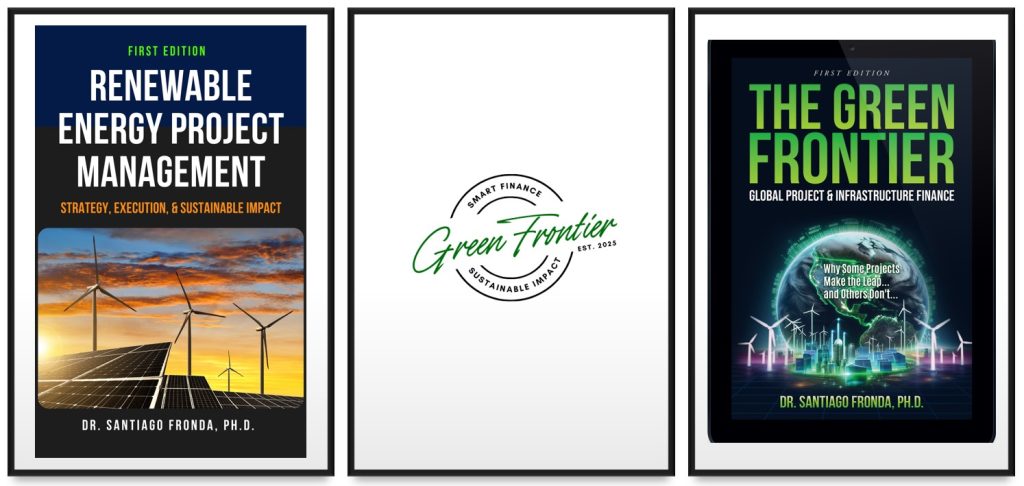
If you found this article helpful, explore Dr. Santiago Fronda’s globally recognized books:
📘 The Green Frontier: Global Project & Infrastructure Finance
A comprehensive playbook for sustainable finance, capital structuring, and green investment strategies.
📗 Renewable Energy Project Management: Strategy, Execution, and Sustainable Impact
A practical guide on leading complex renewable energy projects from concept to commissioning.
Both titles are globally available in digital format. 👉 Visit the Bookstore and Download Your Copy
Empower yourself with the tools trusted by project developers, financial institutions, and infrastructure leaders worldwide.
✒️ About the Author
Dr. Santiago Fronda, PhD is a global thought leader in renewable energy project development, infrastructure finance, and strategic leadership. As the author of The Green Frontier and Renewable Energy Project Management, he brings over 20 years of experience leading complex, billion-dollar infrastructure projects worldwide. Dr. Santiago is the founder of GreenFRONTIER—a platform that empowers finance professionals, developers, and sustainability leaders to deliver impactful, investable, and bankable clean energy solutio

Dr. Santiago Fronda, Ph.D., MBA, is a global leader in project and infrastructure finance, with over two decades of experience structuring multi-billion-dollar clean energy and sustainable infrastructure projects. As the author of The Green Frontier and Renewable Energy Project Management, and CEO of NEOX Development Services Group, Dr. Santiago helps developers, governments, and investors turn climate ambition into bankable projects.