By Dr. Santiago Fronda, PhD, MBA Founder, NEOX Development Services Group Author of The Green Frontier & Renewable Energy Project Management
Introduction: Why the PIM Matters More Than Ever
Many renewable energy projects fail—not because of bad technology but because of poorly structured investment documents. In this guide, I’ll walk you through how to build a Project Information Memorandum (PIM) that attracts capital, satisfies due diligence, and wins investor confidence.
Whether you’re developing a $1.8B green ammonia facility or a modular biofuel refinery, this is your roadmap to credibility.
In today’s climate finance environment, investors aren’t just seeking returns—they’re seeking clarity, confidence, and compliance. Your PIM must speak all three languages.
A PIM isn’t a brochure—it’s a bankability dossier. You’re not selling ambition; you’re presenting instability.
Dr. Santiago Fronda, PhD
Core Structure of an Investor-Ready PIM
Here’s a strategic breakdown of the 10 essential sections every investor-ready PIM should contain—with real examples tailored to green hydrogen, biofuels, and ammonia infrastructure projects. Each section reflects the expectations of development finance institutions (DFIs), export credit agencies (ECAs), sovereign wealth funds, and institutional investors.
1. Executive Summary
Project Snapshot
The project entails the development, construction, and operation of a 250,000 tonnes per annum (tpa) Green Ammonia Production Facility located in Northern Australia, strategically positioned to serve both domestic decarbonization efforts and high-growth export markets across the Asia-Pacific. The facility will be powered by a 700 MW integrated renewable energy platform, comprising utility-scale solar PV and battery energy storage systems (BESS), enabling near-zero emissions ammonia production via water electrolysis and Haber-Bosch synthesis.
Investment Highlights
First-Mover Advantage: One of the earliest large-scale green ammonia facilities in Australia, positioning the project as a frontrunner in the global hydrogen economy.
Robust Market Demand: Strong expressions of interest and advanced discussions with multiple offtakers in Japan, South Korea, and Singapore for long-term supply agreements aligned with net-zero mandates.
Export Readiness: Coastal project site with direct access to port infrastructure, enabling streamlined ammonia export to key Asia-Pacific hydrogen import markets.
Grid-Independent Resilience: Off-grid, renewables-based configuration with co-located electrolyzers and storage improves energy security, reduces operating costs, and enhances project autonomy.
Supportive Regulatory Ecosystem: Aligned with Australia’s National Hydrogen Strategy and the Northern Territory Renewable Hydrogen Master Plan, with secured land tenure and preliminary environmental approvals in place.
Strong ESG Credentials: Contributes to Australia’s 2030 decarbonization goals and aligns with multiple SDGs, notably:
SDG 7: Affordable and Clean Energy
SDG 9: Industry, Innovation, and Infrastructure
SDG 13: Climate Action
Technology and Delivery Partners: Advanced discussions with Tier-1 EPC contractors and OEMs with experience in electrolyzer integration, ammonia handling, and renewable energy assets.
Capital Requirement & Use of Proceeds
The total estimated capital expenditure (CapEx) for the development is USD 1.8 billion, inclusive of:
Renewable Energy Infrastructure (Solar PV + BESS): ~35%
Electrolyzer Systems and Utilities: ~25%
Ammonia Plant and Storage Facilities: ~20%
Site Preparation, Logistics, Port Interface: ~10%
Development, Contingencies, and Working Capital: ~10%
Financing Structure and Ask
The project seeks a blended financing solution, strategically structured to balance project risk and investor appetite:
Equity Ask: USD 300 million (16.7% of total CapEx)
Open to institutional equity, strategic investors, infrastructure funds, and sovereign capital with green mandates.
Concessional Climate Finance (Green Climate Fund, Clean Energy Finance Corp)
Commercial Project Finance Loans (through mandated lead arrangers)
Returns & Investment Rationale
Forecast IRR (Equity): ~14–16% based on conservative offtake pricing and stable renewable inputs.
DSCR: ~1.35–1.45x average during debt tenor, backed by long-term take-or-pay offtake contracts.
Tenor: 15–17 years indicative, with grace period aligned to construction and commissioning.
Exit Options: Clear potential for IPO, trade sale, or long-term yield platform absorption post-FID.
2. Project Overview
Strategic Objective
This project aims to displace carbon-intensive grey ammonia and fossil-based hydrogen with sustainable, green alternatives, supporting industrial decarbonization and maritime fuel transition across the Asia-Pacific. It directly enables zero-carbon logistics, green fertilizer production, and alternative fuels for shipping.
Sector & Subsector Alignment
Primary Sector: Renewable Energy & Green Fuels
Subsectors: Green Ammonia, Electrolytic Hydrogen, Sustainable Fertilizers, Zero-Carbon Maritime Fuels
End Use: Industrial decarbonization, fuel substitution, clean ammonia exports
Sustainability Alignment
The project is fully aligned with Australia’s National Hydrogen Strategy and contributes directly to:
SDG 7 – Affordable and Clean Energy
SDG 9 – Industry, Innovation, and Infrastructure
SDG 13 – Climate Action
This project also contributes to global emissions reduction by displacing approximately 1.2 million tonnes of CO₂ annually through clean ammonia substitution.
3. Market Opportunity
Demand Drivers
European Union: CBAM regulations and RePowerEU are driving urgent clean ammonia imports.
Asia-Pacific: Japan, Korea, and Singapore governments have green ammonia blending mandates and import targets.
Fertilizer Sector: Transition from grey to green ammonia across Asia and Africa driven by ESG-linked procurement and emissions trading compliance.
Maritime Sector: IMO’s GHG reduction targets and green shipping corridors foster ammonia bunkering demand.
Regulatory Tailwinds
EU CBAM (Carbon Border Adjustment Mechanism)
U.S. Inflation Reduction Act (IRA) hydrogen tax credits
Australia Hydrogen Headstart Program & Northern Territory Renewable Hydrogen Strategy
Competitive Benchmarking
Saudi Arabia NEOM: Mega-scale, export-focused
Chile Patagonia: Wind-based ammonia export model
Morocco: Solar-ammonia integration with EU orientation
This project is smaller-scale but faster to market, with significant first-mover advantage in Australia and better proximity to APAC offtakers.
4. Technical & Operational Details
Core Technology Configuration
The project incorporates a modular, high-efficiency configuration designed to ensure technical robustness, operational flexibility, and long-term cost competitiveness:
Electrolyzer System:
Installed capacity of 900 MW, utilizing a hybrid PEM/Alkaline (ALK) configuration to optimize for load flexibility, capex efficiency, and lifecycle performance.
Ammonia Synthesis:
Modular Haber-Bosch reactors, designed for load-following operations, integrated with real-time production and storage balancing systems.
Renewable Power Source:
700 MW Solar PV array co-located with a 250 MWh Battery Energy Storage System (BESS), enabling uninterrupted operation and load leveling for hydrogen production.
Export Handling & Storage:
On-site cryogenic ammonia storage tanks and dedicated portside loading infrastructure, designed for bulk exports and bunkering operations.
Site Advantages
The project location in Northern Australia provides both natural and logistical advantages, enabling competitive LCOE and efficient export logistics:
Exceptional Solar Resource:
Annual solar irradiation exceeding 2,000 kWh/m², ensuring high renewable energy yield and reduced LCOH (Levelized Cost of Hydrogen).
Strategic Export Access:
Direct port connectivity enables low-cost logistics to APAC markets, including Japan, South Korea, and Singapore.
Secured Land & Water Supply:
Long-term land tenure finalized. Industrial-grade desalinated water supply secured via third-party utility under long-term MOU, essential for electrolyzer operations.
EPC+EPCm & O&M Execution Strategy
A de-risked, scalable delivery model underpins the project’s execution timeline, cost control, and operational assurance:
Engineering, Procurement & Construction (EPC+EPCm):
A two-phase Lump Sum Turnkey (LSTK) development approach:
Phase 1: 100,000 tpa capacity
Phase 2: Additional 150,000 tpa—modular scaling ensures capital efficiency and market alignment
Tier-1 EPC and EPCm contractors with proven experience in green hydrogen and ammonia projects are already engaged for front-end engineering and execution planning.
Operations & Maintenance (O&M):
A 10-year O&M agreement with leading OEMs and technology integrators, including:
Performance-linked KPIs covering energy efficiency (kWh/kg NH₃), plant uptime (% availability), emissions performance, and predictive maintenance benchmarks.
Integration of digital twins and real-time diagnostics for operational excellence and cost optimization.
5. Development Status & Timeline
Current Status
Feasibility: Technical, commercial, and ESG feasibility completed (DNV, NexantECA, ERM)
Land: Lease agreement secured with 30-year term + optional extension
Permits: Preliminary environmental approvals received; community consultations underway
Grid: Not connected (off-grid model); battery-supported system approved
Milestone Timeline
Q1 2025 – Financial Close
Q2 2025 – EPC Mobilization and Site Preparation
Q1 2026 – Phase 1 Construction
Q3 2027 – Phase 2 Commissioning
Q4 2027 – Commercial Operation Date (COD)
6. Financial Structure
The project adopts a carefully structured blended finance model to optimize risk allocation, attract diverse capital sources, and ensure long-term investment sustainability. The financing strategy reflects global best practices in project finance for green hydrogen and ammonia infrastructure—balancing concessional, institutional, and commercial sources.
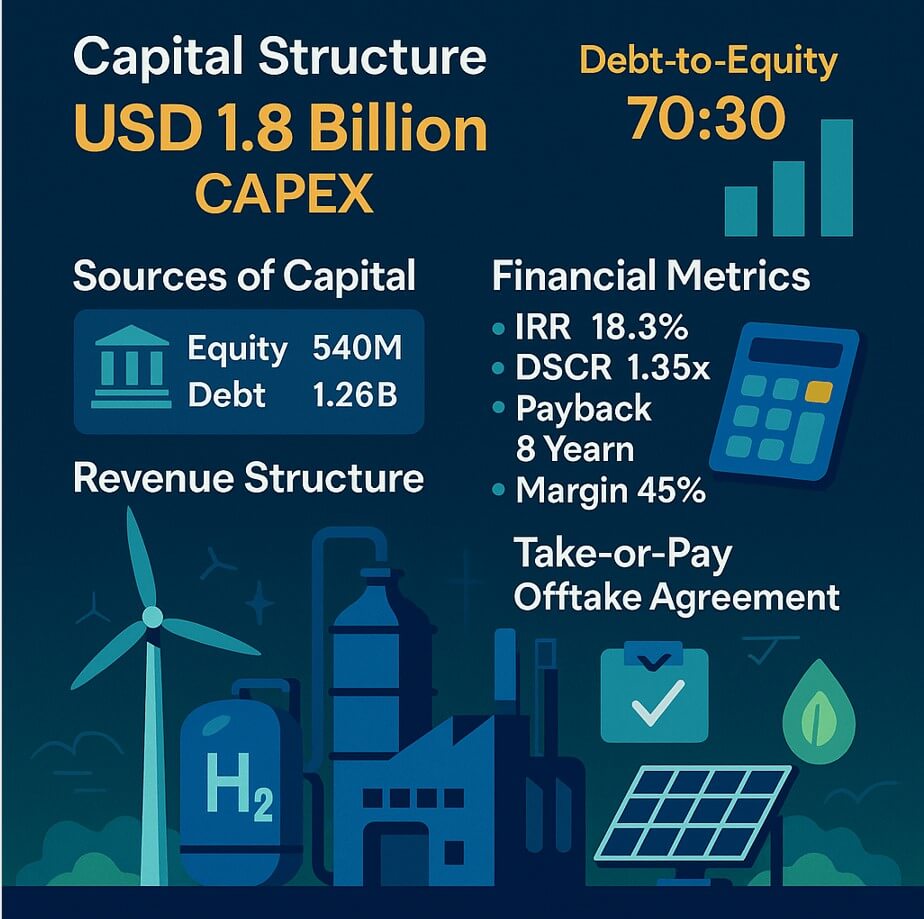
Total Capital Expenditure (CAPEX)
USD 1.8 billion, fully inclusive of EPC costs, contingencies, working capital, and financial close fees.
Debt-to-Equity Ratio
70:30 split, balancing risk appetite and returns between lenders and equity investors while complying with lender DSCR requirements.
Sources of Capital
Equity (USD 540 million):
Sought from infrastructure equity funds, strategic green hydrogen players, sovereign wealth funds (SWFs), and impact-driven institutional investors.
Designed to attract equity partners aligned with long-term yield, ESG performance, and platform scalability.
Debt (USD 1.26 billion):
Structured as a diversified capital stack that includes:
Export Credit Agencies (ECAs): Senior debt and political risk cover from institutions such as:
JBIC (Japan Bank for International Cooperation)
UKEF (UK Export Finance)
Euler Hermes (Germany)
Climate-Conscious Development Finance Institutions (DFIs):
Green Climate Fund (GCF), Asian Development Bank (ADB), Clean Energy Finance Corporation (CEFC)
Green Bonds & Sustainability-Linked Infrastructure Debt Funds:
Private institutional debt offerings with ESG-linked KPIs embedded in pricing and covenants.
This blended structure ensures access to low-cost, long-tenor capital, while aligning with ESG investment mandates and global green finance frameworks.
Key Financial Metrics
Metric
Value
Unlevered IRR
12.5%
Levered IRR
18.3%
Debt Service Coverage Ratio (DSCR)
Avg: 1.35x / Min: 1.25x
Payback Period
8 years
EBITDA Margin
~45% (at steady state)
These metrics reflect a conservative base-case scenario, incorporating stable input costs, indexed pricing, and phased capex deployment.
Revenue Model & Bankability
Offtake Agreement:
A long-term take-or-pay agreement is under negotiation with a top-tier EU-based industrial offtaker, de-risking market exposure and underwriting cash flow certainty.
Indexation Mechanism:
Offtake pricing is linked to green hydrogen market benchmarks, with a built-in inflation escalator and floor price protection—ensuring revenue durability under multiple energy transition scenarios.
Carbon intensity estimated at <0.4 tCO₂/tonne NH₃—among world’s lowest
Social Impact & Inclusion
Active engagement with Indigenous communities; local benefit-sharing agreement in progress
150–200 permanent jobs during operations, with workforce training for underrepresented groups
Gender-Inclusive Employment Policy embedded in hiring and reporting frameworks
Impact Measurement
ESG metrics audited annually
Aligned with SDG impact standards and Sustainalytics/PRI metrics
Climate Resilience Index, Water Use Efficiency, and Scope 1–3 reporting included
9. Sponsors, Developers, and Advisors
Lead Sponsor
NEOX Green Fuels Consortium is a multinational platform with operating assets and development pipelines in green fuels across the Middle East, Australia, and Southeast Asia.
Advisory Team
Function
Advisor
Financial
Neox Development Services Group
Technical
Worley, DNV
Legal
Clifford Chance
ESG & Impact
ERM
Market Pricing
NexantECA
Each advisor was selected for their experience in de-risking bankable green hydrogen and ammonia transactions globally.
10. Investment Ask & Next Steps
Total Capital Requirement
USD 1.8 billion
Equity: USD 540 million
Debt: USD 1.26 billion (secured via ECAs, climate debt funds, and concessional financing)
Funding Status
20% of equity secured via strategic anchor investor
Advanced discussions with multiple DFIs and green infrastructure funds
Preliminary term sheets under review
Ideal Investor Profiles
Development Finance Institutions (DFIs)
Green Infrastructure and Energy Transition Funds
Export Credit Agencies
Sovereign Wealth Funds (SWFs)
Impact Investors and ESG-aligned Institutional Capital
Next Steps
NDA Execution & Teaser Review
Access to Secure Data Room
Investor Due Diligence Support
Term Sheet Negotiation & Final Investment Commitments
Target Financial Close: Q1 2025
What Makes a PIM “Investor-Ready”?
To stand out and secure capital, your PIM must be:
Credible
All claims—market demand, technology, costs—must be backed by third-party validation (feasibility reports, permits, signed offtake letters, etc.).
De-risked
Investors want to know how risks are allocated—technically, legally, financially. Highlight EPC terms, insurance, guarantees, and lender protections.
Data-Rich Yet Focused
Avoid jargon. Use visuals (charts, infographics, maps) and keep content tight. Include annexes or a data room for detailed documents.
ESG-Aligned
Sustainable finance mandates demand transparency. Your ESG strategy should be embedded—not appended.
“A PIM is not a brochure—it’s your project’s opening argument. It must prove that your team, technology, and timeline are ready for capital.”— Dr. Santiago Fronda
The strongest PIMs don’t sell a dream—they structure an opportunity. They demonstrate a real pathway to execution, de-risked outcomes, and shared value. Whether you’re developing a green hydrogen export terminal, an advanced biofuels facility, or a low-carbon ammonia hub, the quality of your PIM may determine whether you unlock the next phase—or stall at the gate.
Summary: What Makes a PIM Investor-Ready?
A well-structured Project Information Memorandum (PIM) for green hydrogen, ammonia, or biofuel projects includes a clear executive summary, strong market validation, robust risk mitigation, an ESG-integrated business case, and detailed financial modeling. It should align with global investor criteria, including DFIs, ECAs, and climate funds. An investor-ready PIM builds trust, showcases feasibility, and drives project bankability.
📥 Call-to-Action:
[🔎 Get the Free PIM Template]
[📩 Join The Green Frontier Newsletter]
[📊 Download Sample Financial Model for Renewable Projects]
Empower yourself with the tools trusted by project developers, financial institutions, and infrastructure leaders worldwide.
✒️ About the Author
Dr. Santiago Fronda, PhD is a global thought leader in renewable energy project development, infrastructure finance, and strategic leadership. As the author of The Green Frontier and Renewable Energy Project Management, he brings over 20 years of experience leading complex, billion-dollar infrastructure projects worldwide. Dr. Santiago is the founder of GreenFRONTIER—a platform that empowers finance professionals, developers, and sustainability leaders to deliver impactful, investable, and bankable clean energy solutions.
Dr. Santiago Fronda, Ph.D., MBA, is a global leader in project and infrastructure finance, with over two decades of experience structuring multi-billion-dollar clean energy and sustainable infrastructure projects. As the author of The Green Frontier and Renewable Energy Project Management, and CEO of NEOX Development Services Group, Dr. Santiago helps developers, governments, and investors turn climate ambition into bankable projects.
Dr. Santiago Fronda, Ph.D., MBA, is a global leader in project and infrastructure finance, with over two decades of experience structuring multi-billion-dollar clean energy and sustainable infrastructure projects. As the author of The Green Frontier and Renewable Energy Project Management, and CEO of NEOX Development Services Group, Dr. Santiago helps developers, governments, and investors turn climate ambition into bankable projects.